In the high-stakes landscape of competitive examinations like the JEE, we are witnessing a paradigm shift. For decades, the "Factory Model" of education—mass lectures and standardized testing—was the only way to scale learning. However, recent breakthroughs in Cognitive Science and Machine Learning are proving that the next leap in student performance won't come from more hours of study, but from Algorithmic Precision.
At Fusion Classes, we have been analyzing the trajectory of top rankers, and the data is clear: The future of "cracking" the JEE lies in the transition from Linear Learning to Adaptive Feedback Loops.
1. The Death of the "Average" Student
In a classroom of 50, the teacher must teach to the "mean." This creates a "Knowledge Gap" for the advanced student (who is bored) and the struggling student (who is lost).
The Research: Educational psychologists have long discussed Bloom’s 2 Sigma Problem, which states that students tutored one-on-one perform two standard deviations better than those in a classroom.
The AI Solution: AI effectively solves this "Scaling Problem." It provides a 1:1 Dynamic Tutoring experience. By analyzing millions of data points from thousands of students, AI can predict exactly when your understanding of a concept like "Entropy" is beginning to fade and intervene before the "Forgetting Curve" takes hold.
2. Neuroplasticity and the "Zone of Proximal Development"
Success in JEE Physics or Mathematics requires deep neuroplasticity—the brain’s ability to rewire itself to solve complex problems.
The Deep Study: Effective learning happens in the Zone of Proximal Development (ZPD)—the sweet spot between "too easy" and "too difficult."
The Future of Practice: AI-powered platforms use Item Response Theory (IRT) to ensure every single practice problem you solve is exactly at the edge of your capability. If a problem is too easy, you waste time; if it’s too hard, you face "Cognitive Load" and give up. AI ensures you stay in the "Flow State" for maximum growth.
3. Predictive Error Analysis: Beyond the Mistake
Traditional "Error Correction" is reactive—you get a question wrong, you look at the solution, and you move on. AI makes it proactive and diagnostic.
Pattern Recognition: A human mentor might see that you got a "Projectile Motion" question wrong. An AI algorithm sees that you consistently fail Projectile Motion questions only when they involve Calculus-based limits.
The Future: This level of "Granular Diagnosis" allows for a surgical strike on your weaknesses. Instead of re-reading an entire chapter, you spend 10 minutes fixing the specific mathematical hurdle that was blocking your Physics score.
4. Quantifying the "Intangibles": Speed and Stamina
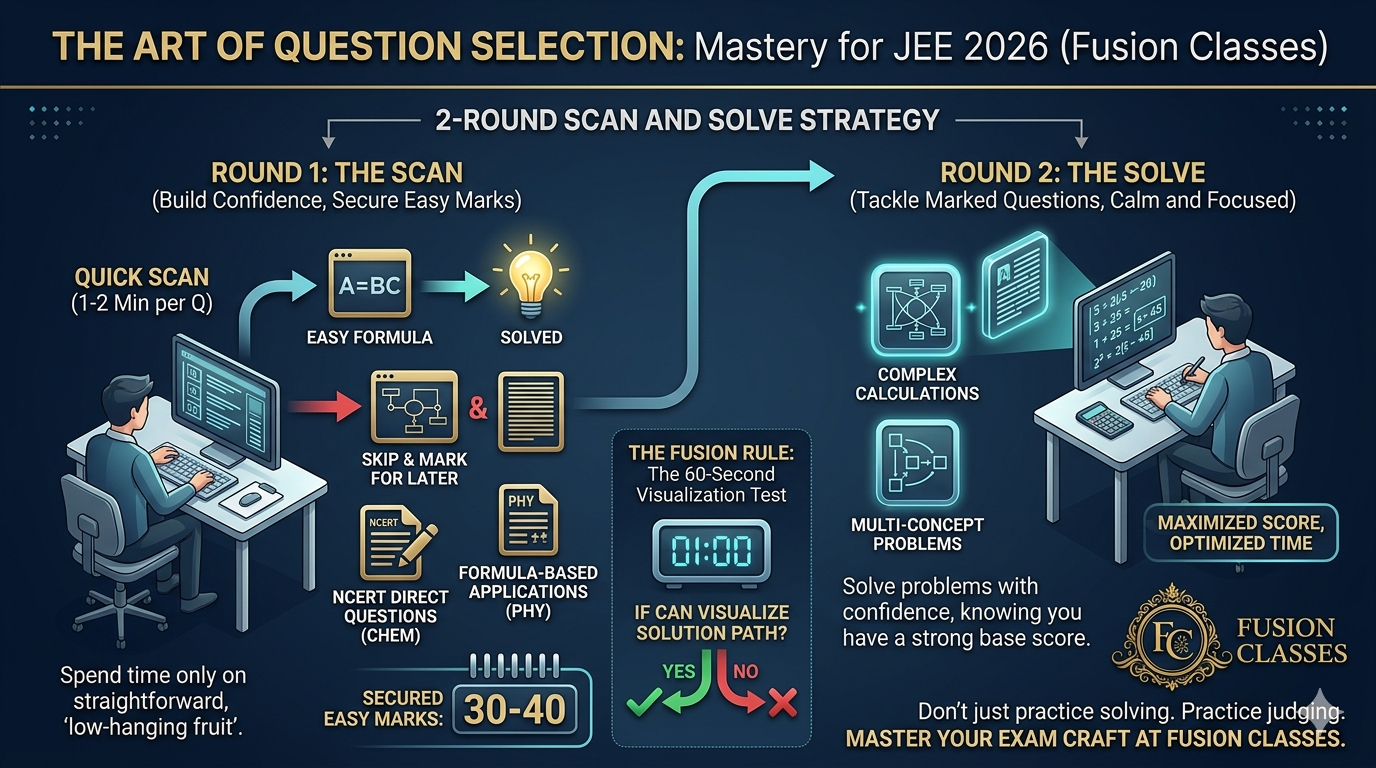
JEE isn't just about what you know; it’s about how you perform under 180 minutes of intense pressure.
The Study of "Decision Fatigue": Research shows that students often make "Silly Errors" not because they lack knowledge, but due to a drop in cognitive stamina in the third hour of the exam.
The Digital Twin: Future preparation involves creating a "Digital Twin" of your testing persona. AI tracks your accuracy decay over 3 hours and identifies exactly when your "Decision Fatigue" kicks in. It then builds a custom "Stamina Training" module to push that threshold further.
The Verdict: Adaptation is Survival
The IITs are looking for the best problem-solvers in the nation. As the exam evolves, the tools we use to conquer it must evolve too. We are moving away from the era of "Books and Pens" into the era of "Data and Insights."
At Fusion Classes, we believe that students who embrace this AI-driven cognitive shift will not just compete—they will dominate. The technology isn't just a tool; it is a cognitive exoskeleton that allows you to process, retain, and execute at a level that was humanly impossible a decade ago.