At Fusion Classes, we have a counter-intuitive piece of advice for all JEE aspirants: In a competitive exam, the questions you choose not to solve are just as important as the ones you do.
Most students enter the exam hall with a completion mindset. They want to solve 75 questions. The harsh reality of JEE Main 2026 is that a top rank (or securing that dream NIT branch) often requires only 50 to 55 correct questions with high accuracy. The difference between a 95th percentile and a 99th percentile often comes down to just 4 or 5 correct decisions about which questions to tackle.
Question Selection is an art, and like any art, it requires practice, judgment, and a calm mind. Here is your guide to mastering it.
1. The "Speed Breaker"
A "Speed Breaker" is a question that is designed not to test your knowledge, but to consume your time and rattle your confidence. It looks deceptively simple, but the calculation is tedious or has a hidden catch.
The Trap: Students feel that they should be able to solve it. They invest 3 minutes, then 5. Now, they are "committed" and feel they can't leave without the answer. This is typical "escalation of committment" trap
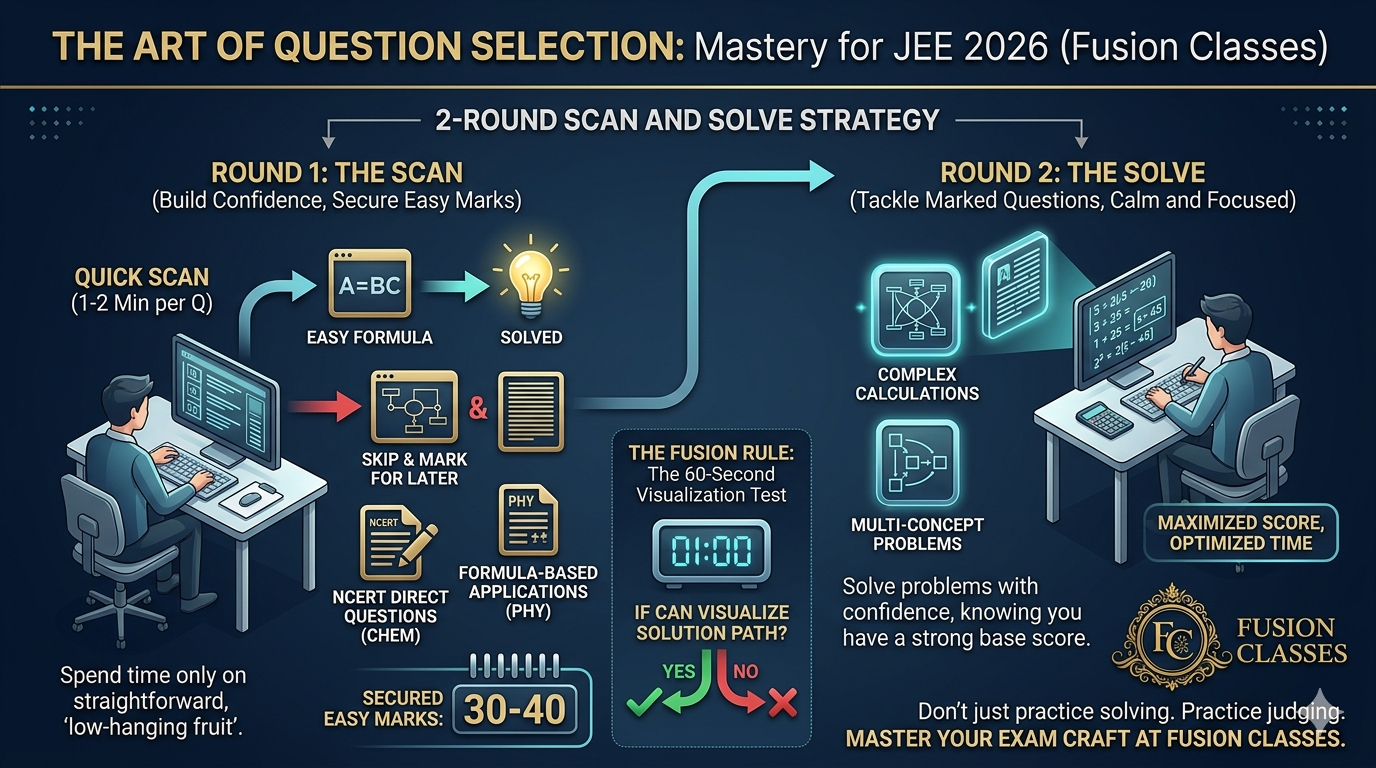
The Fusion Rule: If you cannot visualize the complete solution path within the first 60 seconds, mark it for later (or never) and move on. There are plenty of easier marks waiting on the next page.
2. Ditching your (Subject) Ego
This is the hardest hurdle for top students. If you are strong in Physics, you feel it’s your "duty" to solve every single Physics problem. This "Subject Ego" is a common reason why well-prepared students fail.
The Reality: A tough 4-mark question in Physics takes 8 minutes. A simple 4-mark question in Chemistry takes 60 seconds. NTA gives you the same 4 marks for both.
The Strategy: The exam hall is a battlefield, not a place to show off your love for a subject. Treat every question as an opportunity to gain 4 marks or lose 1. Be ruthless and choose the path of least resistance.
3. The 2-Round "Scan and Solve" Strategy
Never try to solve the paper in one linear go (from Q1 to Q75). This approach guarantees that you will be fatigued by the time you reach easier questions at the end.
Round 1 (The "Scan"): Go through the entire paper subject by subject. Solve only the straightforward questions—the "low-hanging fruit." These are NCERT direct questions in Chemistry, or formula-based applications in Physics. In this round, you are buying time and building immense confidence.
Round 2 (The "Solve"): Now that you have secured 30-40 "safe" questions, go back and tackle the questions you marked. These are the ones where you knew the concept but required longer calculations. You can now solve these with a calm mind, knowing you already have a strong base score.
The Fusion Perspective: "Your dream rank isn't determined by your ability to solve every difficult question. It is determined by your wisdom to avoid the pitfalls and maximize your score using the easiest questions first."
Final Words
Question Selection is the bridge between your Preparation (knowledge) and your Preparedness (strategy). In these final weeks, do not just practice solving problems; practice judging problems. Learn to say "NO" to the difficult, time-consuming questions so that you have the time and energy to say "YES" to the easy marks that NTA is offering.