At Fusion Classes, we often see students wearing their "12-hour study days" like a badge of honour. But it is not about how many hours you study; it is about how effectively you study.
True excellence in competitive exams like JEE,NEET doesn't come from mindless grinding. It comes from developing a holistic and deeper understanding of concepts, which is the only way to ensure long-term memory retention.
The Science of Memory: Depth and Decay
According to the Level of Processing approach of memory, the deeper we process information, the better we retain it. If you simply skim a page, it stays on the surface; if you analyse it, it roots into your memory.
However, there is another side to the truth of memory:
Natural Decay: Over time, even well-learned information fades.
Interference: Similar pieces of information can get "tangled" in your brain, causing confusion.
To overcome this, you must build a system of frequent revision. To help you get started, I have listed four pillars of effective study that we emphasize at Fusion Classes.
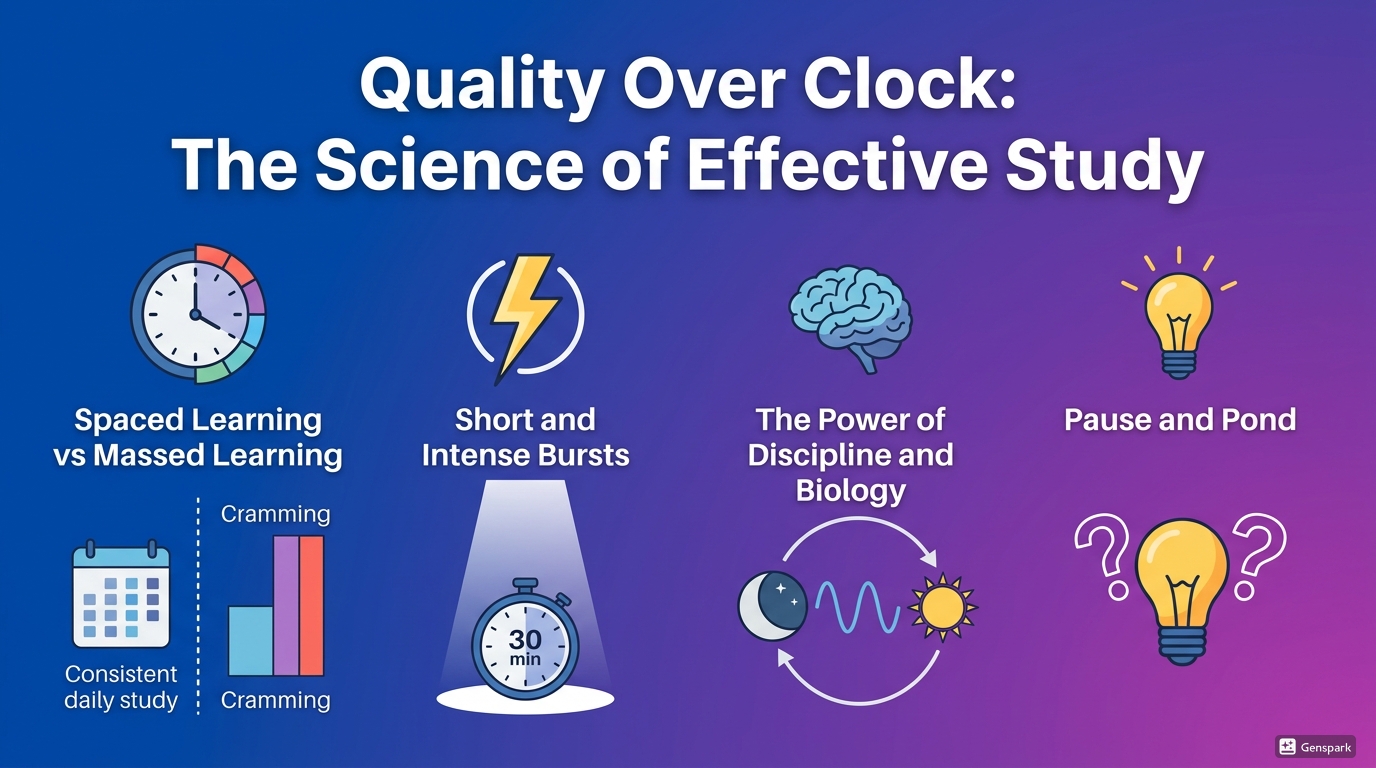
1. Spaced Learning vs. Massed Learning
Have you ever tried to "cram" 12 hours of study into a single day, only to do nothing for the next two days? This is called Massed Learning, and it is highly ineffective.
The Strategy: Learning should be distributed over the whole day, weeks, and months.
The Comparison: Studying consistently for 4 hours every day is far more effective than an occasional 12-hour marathon followed by burnout.
2. Short and Intense Bursts
Long, "diffused" study sessions where you are half-distracted by your surroundings are a waste of time.
The Goal: Your study sessions should be short but intense.
The Benefit: Thirty minutes of deep, focused concentration is more valuable than three hours of sitting with a book while your mind wanders.
3. The Power of Discipline and Biology
Being disciplined isn't just about finishing the syllabus; it’s about respecting your biology.
Circadian Rhythm: Developing a schedule and sticking to it aligns your brain with its natural rhythm.
The Sleep Factor: Sleep plays a crucial role in memory consolidation, making proper rest absolutely non-negotiable. Maintaining a disciplined routine helps keep your sleep pattern undisturbed, allowing your waking hours to become significantly more productive. Moreover, sleep should ideally occur in one continuous stretch rather than being broken into multiple phases. Research suggests that the brain’s deeper recovery processes begin only after about four hours of sleep. Therefore, a single uninterrupted stretch of 7–8 hours is far more beneficial than sleeping for two hours at a time across four separate intervals. Although the total sleep duration may be the same in both cases, the quality of recovery in the fragmented pattern is considerably poorer.
4. Pause and Ponder
The biggest mistake students make is "skimming" to finish a chapter quickly.
Ask "Why?": While studying any topic, you must pause and ponder. Always ask why a concept works the way it does and strive to find that answer.
Faster Pace: Ironically, when you stop to ponder, you actually understand concepts at a faster pace in the long run because you aren't constantly having to re-learn forgotten material.
The Fusion Perspective: Remember, your brain is like a muscle—train it with precision, not just volume."